
September 2026, Calgary AB,
A five-year, Canadian $ 1,000,000 funding package from Energi Simulation is the focus of an Industrial Research Chair in “PETROLEUM FIELD MANAGEMENT IN THREE STAGES”, at the University of Campinas, UNICAMP, Brazil. Since the launch of Dr. Denis Schiozer’s chair in 2015, Energi Simulation has contributed $2.4 million Canadian to support his research team and program.
The chair will support a team of research associates and students to undertake leading edge research in innovative methods for closed loop reservoir management, integration of models and data, and short-term decisions.
“Energi Simulation is thrilled to be able to continue our long term relationship with Professor Denis Schiozer and his team for another 5 years! This world class research will help to provide a sustainable energy future for the world through innovative technology and training. We are proud to play a role in this exciting initiative!”
Duke Anderson, President, Energi Simulation
“The continued support of Dr. Denis Schiozer’s Research Chair is a strong recognition of the importance of this initiative to our university. Over the past years, the Chair has made significant contributions to advancing innovative approaches to oil reservoir management, while also strengthening the education and development of highly qualified professionals in this field. Research and innovation in the responsible and efficient use of energy resources are essential to addressing the challenges of the energy transition. We are grateful to Energi Simulation for its continued partnership and commitment to this important initiative.”
Prof. Dr. Paulo Cesar Montagner – Rector, UNICAMP
The central idea of the Chair is to continue the improvements of the methodology for life-cycle, short-term and real time decisions for petroleum field management using machine learning data-driven and simulation models of different fidelities. Some improvements were made in the past few years and this methodology is being prepared to be used in digital reservoir management.
Dr. Schiozer has over 35 years of experience in the area of reservoir management and simulation. Schiozer joined the faculty at UNICAMP in 1988 and holds a Ph.D. degree in Petroleum Engineering from Stanford University, an M.S. degree in Petroleum Engineering from University of Campinas (UNICAMP), a B.S. in Aeronautical Engineering from the Technological Institute of Aeronautics (ITA) and an M.B.A in Administration from Getúlio Vargas Foundation (FGV). He had more than 70 financed projects from the oil industries and has been coordinating UNISIM (Research group on Reservoir Simulation) for 30 years.
About UNICAMP
Unicamp was founded on October 5, 1966. It is a young institution but has already developed a strong tradition in education, research and services to society. The university is from the State of São Paulo that accounts for 40% of Brazil’s industrial capacity and 25% of its economically active population. Unicamp has three campuses which are home to 22 teaching and research Institutes and Schools. It also has a vast hospital complex; 23 interdisciplinary centers; two technical high schools; and a series of support units within a universe of about 50 thousand people in which thousands of research projects are carried out.
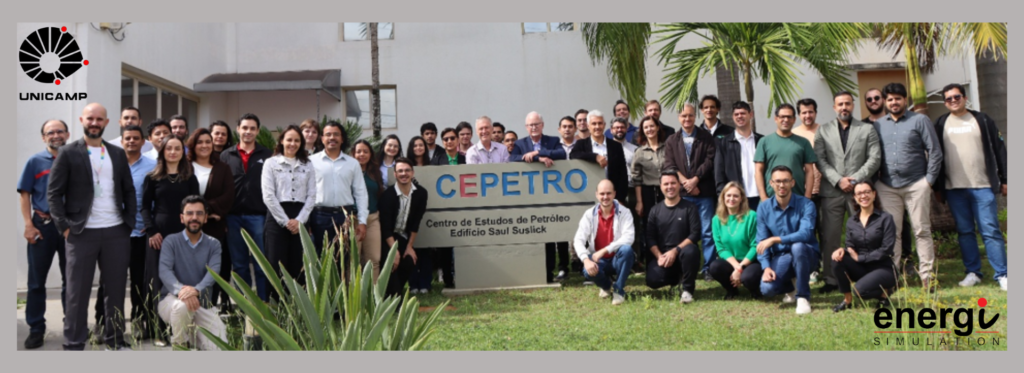
The Center for Energy and Petroleum Studies (CEPETRO), the graduate program in Petroleum Engineering and the Department of Petroleum Engineering (DEP) were created in 1987 in order to enable broad cooperation between the two institutions and promote research and the training of human resources in oil business. Today, CEPETRO has many research activities and many projects financed mainly by oil companies, state of São Paulo and ANP (Brazilian National Oil Agency).
Brazil has a law that establish that part of the revenues from the oil industry must be invested in research in the country; this had a significant impact on the research in energy and petroleum areas in the country and yield a high number of cooperation agreements of CEPETRO and oil companies.
UNISIM, one of the laboratories of CEPETRO, was created in 1996 by a partnership between Petrobras, UNICAMP and FAPESP, with an agreement between the University and the companies for technological innovation. UNISIM achieved 30 years and had, as main results: The research group is on track to graduate nearly 150 PhD and MSc students, with more than 700 articles published and 76 funded projects and several awards.